MCCS committee members deliver expert-led education at Cannabis Health Symposium
November 27, 2025 | IN EVENTS | BY Kate Thorpe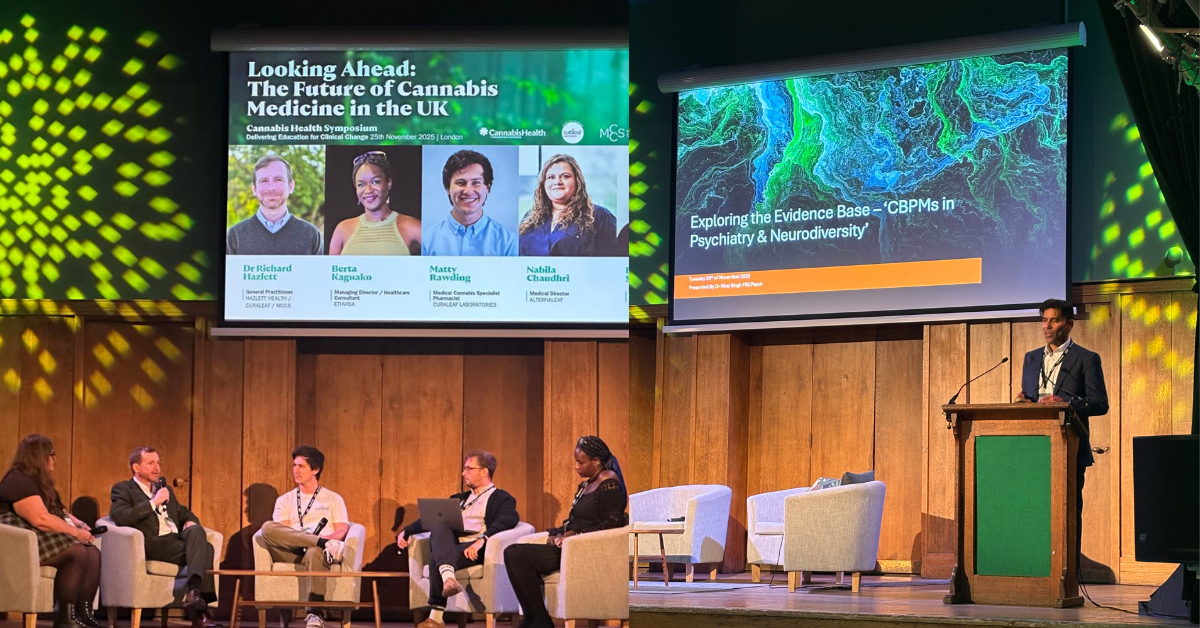
Earlier this week, the Medical Cannabis Clinicians Society was proud to co-host the UK’s first Cannabis Health Symposium, where several of our executive committee members contributed to a packed agenda of education on cannabis-based medicine.
Out of almost 200 delegates, the event welcomed around 100 doctors – including 50 who had never prescribed medical cannabis before – to hear expert-led presentations, clinical case studies, and practical guidance to gain a deeper understanding of how it can safely and effectively support patients with a range of health conditions.
The Society was delighted to have several representatives presenting on the day and to welcome many new clinicians interested in prescribing safely, confidently, and in line with best practice.
Read on for a summary of some of the key talks by our MCCS committee members.
Building Prescriber Confidence: Best Practice, Training, and Governance | Professor Mike Barnes
MCCS Chair, Professor Mike Barnes opened the symposium by setting out the current landscape of UK medical cannabis prescribing and the clinical standards needed to safeguard patients. With around 80,000 patients and only 160 active prescribers – almost all in the private sector – he highlighted wide variation in practice quality, from excellent multidisciplinary clinics to services offering unsafe 10-minute consultations and limited communication with GPs.
Prof Barnes reiterated key principles from the MCCS Good Practice Guide, emphasising the importance of evidence-based product selection and advising clinicians to focus on chemovars and Certificates of Analysis rather than terminology like ‘indica’ and ‘sativa’. He also called for modernisation of the sector, from electronic prescribing to improved training pathways, arguing that clinical decisions must remain independent from commercial pressures.
🔗 Explore more about Good Practice in medical cannabis
NHS Integration – Bridging the Gap Between NHS and Private Providers | Dr Rob Forbes & Dr David Tang
Committee members Dr Rob Forbes and Dr David Tang took part in a panel discussion focused on the two-tier system created by the lack of NHS prescribing of CBPMs, hindered by strict unlicensed medicine rules, a lack of NICE advocacy, and institutional risk aversion. They described barriers ranging from stigma and poor communication to the misclassification of CBPMs as ‘cannabis misuse disorder’ in NHS records.
Panelists called for practical, system-level solutions such as shared documentation standards, interoperable digital systems, GP engagement, and national guidance clarifying responsibilities between sectors. They emphasised that private providers must “get their house in order” on data quality and communication, while NHS stakeholders need clearer pathways and better education.
Exploring the Endocannabinoid System | Dr Rowan Thompson
Dr Rowan Thompson delivered an engaging introduction to the endocannabinoid system (ECS), explaining its core components and its regulatory role across pain, mood, sleep, appetite, immune response, and cognition. Thompson also explored how diet, metabolic health, and chronic disease affect ECS tone, helping explain wide variation in patient responses to THC and CBD.
ECS dysregulation, he noted, is implicated across conditions commonly treated with CBPMs, from migraine and IBS to fibromyalgia and substance use disorders. Despite being one of the body’s major regulatory systems, the ECS is absent from all UK medical curricula, an omission he argued must be urgently addressed to support safe, effective prescribing.
The Role of the Pharmacist: Best Practice for Dispensing CBPMs | Zul Mamon
Pharmacist and expert committee member Zul Mamon presented an insightful account of current pharmacy-side challenges through the story of ‘Sarah’, a patient whose prescribing journey was marked by delays, poor communication, and uncertainty about how to use her medication. Mamon connected this experience to findings from the 2025 GPhC inspection, which identified widespread issues across 24 CBPM pharmacies, including inadequate access to clinical records, inconsistent safety checks, and insufficient pharmacist involvement in patient education.
He argued that pharmacists must act as clinical gatekeepers, providing safety verification, interaction checks, clear dosing guidance, and ongoing monitoring. To achieve this, the sector needs better training, more robust procurement processes, digital stock tracking, and structured communication between clinics and pharmacies.
🔗 Read Zul Mamon’s detailed blog taken from his presentation.
Exploring the Evidence Base: CBPMs in Psychiatry & Neurodiversity | Dr Niraj Singh
Consultant Psychiatrist, Dr Niraj Singh, explored the complex interface between CBPMs and psychiatric or neurodevelopmental conditions, where symptoms often overlap and patients present with multi-system needs. He noted that evidence points to meaningful benefits for selected individuals across anxiety, PTSD, mood instability, agitation, and autism-related symptoms.
Drawing on clinical experience, Dr Singh discussed atypical responses in neurodivergent patients, sex-based differences in THC requirements, and the value of balanced oils for daytime functioning. He stressed the need for cautious titration, robust follow-up, and clinician understanding of vulnerabilities such as trauma, emotional dysregulation, or sensory sensitivity.
Looking Forward: The Future of Cannabis Medicine in the UK | Dr Richard Hazlett
GP, Dr Richard Hazlett, took part in a forward-looking panel which discussed how to scale medical cannabis responsibly over the next five years. Panelists envisioned GP-initiated prescribing, NHS engagement, and more accessible formats such as vapourisers, pastilles, and transdermal systems. Education emerged as the most significant bottleneck, with almost no ECS content in medical training. The panel called for impartial, evidence-based guideline development led by professional bodies, alongside more regulatory engagement as patient numbers rise.
They also highlighted major cost-saving opportunities for the NHS, citing conditions like cluster headache and the broader potential for reduced polypharmacy and return-to-work outcomes. If one change could be made today, panellists prioritised enabling specialist GPs to prescribe, expanding product formats, and establishing robust training pathways.
Exploring the Evidence Base: CBPMs for Pain Management | Professor Mike Barnes
Returning to the stage, Professor Barnes reviewed the substantial evidence supporting CBPMs for chronic pain, which represents 55% of UK prescriptions. He presented data from 66 RCTs and over 20,000 participants demonstrating efficacy across neuropathic, arthritic, spasticity-related, cancer-related, and post-surgical pain. THC is the primary analgesic agent, supported by multiple minor cannabinoids and terpenes, while CBD contributes by improving sleep and anxiety.
Typical therapeutic doses range from 10–30 mg THC per day, with real-world averages around 15 mg, and no evidence of tolerance escalation. Prof Barnes also highlighted strong data showing opioid reductions of up to 50% in many patients and potential population-level benefits in reducing opioid-related deaths. He referenced the health economics analysis which suggested medical cannabis could save billions for the NHS through reduced medication burden and improved functional outcomes.
Beyond the Benefits: Recognising Risks, Side-effects & Contraindications of CBPMs | Dr Jenny Forbes
Dr Jennifer Forbes, GP and addictions specialist, offered a practical overview of the key risks, side-effects and contraindications associated with prescribing unlicensed CBPMs, emphasising that rising patient demand must be matched with careful, accountable clinical practice. She highlighted how different formulations carry varying risk profiles, with oils and capsules offering more predictable dosing, while flower and vape cartridges deliver faster onset but higher THC peaks and increased likelihood of adverse events. Drug–drug interactions were underscored as a major concern, particularly CBD-related CYP450 inhibition affecting medications such as clobazam, SSRIs and warfarin.
Forbes stressed the importance of structured risk–benefit reasoning, thorough history-taking and clear communication about the unlicensed nature of treatment, driving rules and pregnancy considerations. She encouraged clinicians to titrate slowly, aim for the lowest effective THC exposure, and to use regular reviews, symptom diaries and the MHRA Yellow Card scheme to monitor safety.
Practicalities for Prescribing CBPMs in Women’s Health | Dr Dani Gordon
Dr Dani Gordon explored the wide applicability of CBPMs across women’s health, including menopause, PMDD, endometriosis, chronic pelvic pain, postpartum symptoms, and neurodivergent presentations. She emphasised that women often present with interconnected issues making cannabis particularly suited to holistic symptom modulation.
Gordon discussed mechanisms including inflammation modulation, stress-axis regulation, and emerging evidence around mast cell involvement in endometriosis. She noted that women may require lower THC doses on average, and that oils are typically first-line, with inhaled options reserved for acute symptoms. Tracking symptoms across the menstrual cycle is essential for prescribing, as responses to cannabinoids may shift with hormonal fluctuations.
How to prescribe medical cannabis workshops
The Society also hosted two successful workshops during the event. Committee members Dr Jen Forbes and Dr Richard Hazlett, alongside Richard Cupit of PiB Insurance, delivered a session on How to Start Prescribing Medical Cannabis. This was followed by an overview of best practice and guidelines for dosing medical medical cannabis, delivered by Dr Rowan Thompson, an editor of our new publication on this topic.
A big thank you to all the clinicians and Society members who took part on the day.
New training and resources based on the committee-led talks will be available soon for any members who were unable to attend the symposium. Looking to join the Society? Find out more and sign up here.