MCCS committee members deliver expert-led education at Cannabis Health Symposium
November 27, 2025 | IN EVENTS | BY Kate Thorpe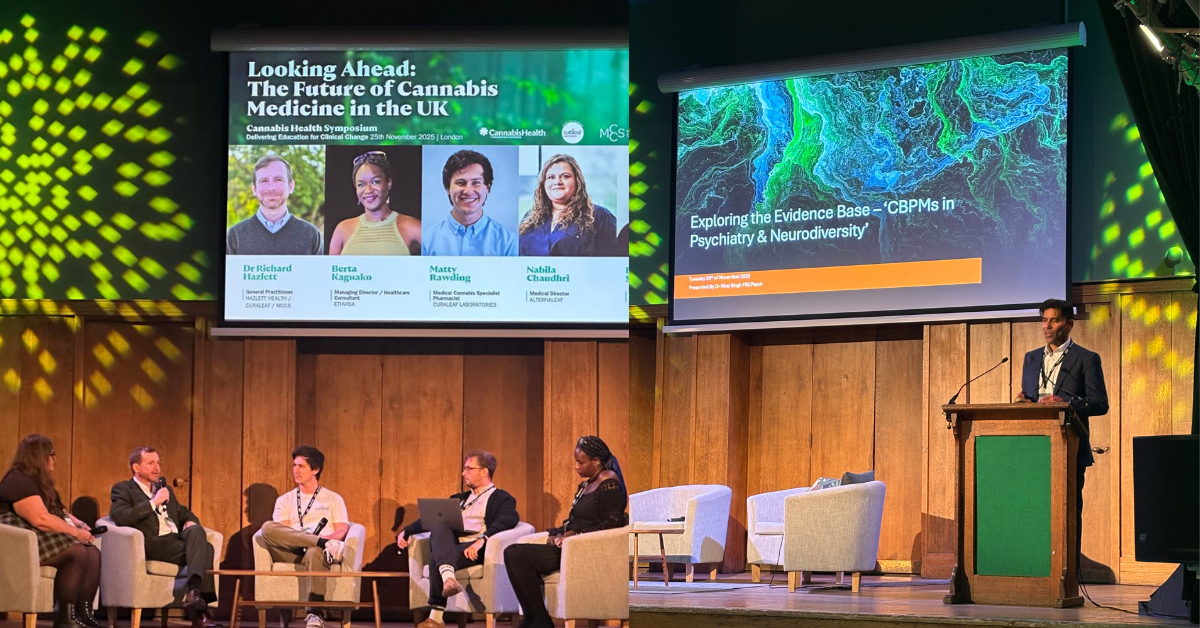
Earlier this week, the Medical Cannabis Clinicians Society was proud to co-host the UK’s first Cannabis Health Symposium, where several of our executive committee members contributed to a packed agenda of education on cannabis-based medicine.
Out of almost 200 delegates, the event welcomed around 100 doctors – including 50 who had never prescribed medical cannabis before – to hear expert-led presentations, clinical case studies, and practical guidance to gain a deeper understanding of how it can safely and effectively support patients with a range of health conditions.
The Society was delighted to have several representatives presenting on the day and to welcome many new clinicians interested in prescribing safely, confidently, and in line with best practice.
Read on for a summary of some of the key talks by our MCCS committee members.
Building Prescriber Confidence: Best Practice, Training, and Governance | Professor Mike Barnes
MCCS Chair, Professor Mike Barnes opened the symposium by setting out the current landscape of UK medical cannabis prescribing and the clinical standards needed to safeguard patients. With around 80,000 patients and only 160 active prescribers – almost all in the private sector – he highlighted wide variation in practice quality, from excellent multidisciplinary clinics to services offering unsafe 10-minute consultations and limited communication with GPs.
Prof Barnes reiterated key principles from the MCCS Good Practice Guide, emphasising the importance of evidence-based product selection and advising clinicians to focus on chemovars and Certificates of Analysis rather than terminology like ‘indica’ and ‘sativa’. He also called for modernisation of the sector, from electronic prescribing to improved training pathways, arguing that clinical decisions must remain independent from commercial pressures.
🔗 Explore more about Good Practice in medical cannabis
NHS Integration – Bridging the Gap Between NHS and Private Providers | Dr Rob Forbes & Dr David Tang
Committee members Dr Rob Forbes and Dr David Tang took part in a panel discussion focused on the two-tier system created by the lack of NHS prescribing of CBPMs, hindered by strict unlicensed medicine rules, a lack of NICE advocacy, and institutional risk aversion. They described barriers ranging from stigma and poor communication to the misclassification of CBPMs as ‘cannabis misuse disorder’ in NHS records.
How Mobile Technology Changed the Way Canadians Access This Site of Gaming
The rise of smartphones fundamentally reshaped how Canadians interact with digital entertainment, and few sectors felt that shift as dramatically as online gaming. Between 2010 and 2020, mobile internet adoption in Canada climbed from roughly 40 percent of the population to over 85 percent, according to data from the Canadian Radio-television and Telecommunications Commission. That expansion did not simply add a new device to the mix — it restructured the entire relationship between players and gaming platforms, altering when, where, and how often Canadians chose to engage. Understanding that transformation requires looking beyond the hardware itself and examining the regulatory, technological, and behavioral currents that carried it forward.
The Regulatory Landscape That Made Mobile Gaming Viable in Canada
Canada’s approach to online gaming has always been shaped by its federal structure, with provinces holding significant authority over gambling regulation. For most of the 2000s, that fragmented authority created uncertainty for both operators and players. Ontario’s iGaming framework, which came into full effect in April 2022, marked a turning point. For the first time, a major Canadian province created a competitive, regulated market where private operators could be licensed to offer real-money gaming to residents. That regulatory clarity had a direct effect on mobile development investment: operators who had previously been cautious about building polished, native mobile applications suddenly had a legal and commercial reason to do so.
Before Ontario’s framework, provincial lottery corporations like OLG (Ontario Lottery and Gaming Corporation) and Loto-Québec operated the only officially sanctioned online platforms in their respective jurisdictions. These platforms were functional but not optimized for the mobile experience that players increasingly expected. The arrival of licensed private operators brought with it years of accumulated mobile UX research and development from European and other regulated markets, accelerating the quality of what Canadian players could access on their phones almost overnight.
How Smartphone Hardware Drove Behavioral Change Among Canadian Players
The hardware improvements that arrived between 2015 and 2022 were not incremental — they were structural. The shift from 3G to 4G LTE networks, and then to 5G rollouts beginning in 2020 with carriers like Bell, Rogers, and Telus, reduced latency to the point where live-dealer gaming formats became genuinely playable on a mobile connection. Earlier, a live-streamed casino table game was prone to buffering and disconnection on a mobile network; by 2021, the same session on a 5G connection was often indistinguishable in quality from a desktop experience.
Screen size also played a role that is often underestimated. The average smartphone screen size grew from roughly 3.5 inches in 2010 to over 6.3 inches by 2022. That physical change made interface elements — card values, game controls, account menus — large enough to interact with comfortably without a mouse and keyboard. Game developers responded by redesigning interfaces specifically for portrait and landscape mobile orientations rather than simply scaling down desktop layouts. The result was a product that felt native to the device rather than adapted for it.
Canadian players also shifted their session patterns in measurable ways. Desktop gaming sessions had historically been longer and concentrated in evening hours. Mobile sessions, by contrast, became shorter and more distributed throughout the day — during commutes, lunch breaks, and brief periods of downtime. This behavioral shift pushed operators to rethink game design, favoring shorter round times, faster loading, and streamlined account access. The data gathered from mobile sessions also gave operators a more granular picture of player behavior than desktop analytics had ever provided, enabling more precise responsible gaming tools and session-time notifications.
Platform Architecture and the Technical Infrastructure Behind the Shift
The transition to mobile was not simply a matter of players switching devices. It required a fundamental rethinking of how gaming platforms were built and maintained. Early online gaming platforms were developed using Flash-based technology, which Apple’s iOS had blocked since 2010. That decision by Apple effectively forced the entire industry to migrate to HTML5, a process that was largely complete by 2017. HTML5 allowed games to run directly in a mobile browser without requiring a plugin, which dramatically lowered the barrier to access. A player in Vancouver or Halifax could open a browser on an Android or iOS device and begin playing within seconds, without downloading dedicated software.
The parallel development of dedicated mobile applications added another layer. Native apps, distributed through the Apple App Store and Google Play Store, allowed for push notifications, biometric login, and tighter integration with device hardware like cameras for identity verification. Some operators chose a hybrid approach, maintaining a browser-based experience alongside a downloadable app, giving players the choice that suited their preference. The technical complexity of maintaining both pathways increased operating costs, but the player acquisition data consistently showed that users who downloaded a native app had significantly higher retention rates than those who accessed platforms through a browser alone.
Payment infrastructure adapted in parallel. Mobile wallets like Apple Pay and Google Pay became supported deposit methods on a growing number of Canadian gaming platforms after 2019, removing the need to manually enter card details on a small screen. Interac e-Transfer, already familiar to most Canadians from everyday banking, became one of the most widely used deposit and withdrawal methods in the country specifically because it was designed for mobile-first use. The friction that had previously discouraged mobile transactions — fumbling with card numbers, expiry dates, and CVV codes — was substantially reduced, and conversion rates on mobile deposit attempts rose accordingly. Players researching their options across different platforms can find detailed comparisons on this site, where the technical specifications and payment options for various Canadian-accessible platforms are documented in a structured format.
Responsible Gaming Tools and the Mobile Advantage
One dimension of mobile gaming that receives less attention than it deserves is the effect that smartphone technology has had on responsible gaming infrastructure. Provincial regulators and operators alike have invested in tools designed to help players monitor and manage their activity, and mobile platforms have made those tools more effective in several concrete ways. Real-time session tracking, spend notifications, and deposit limit management are easier to implement and more immediately visible on a mobile interface than they were on desktop platforms, where such features were often buried in account settings menus.
The Responsible Gambling Council of Canada, which operates the national self-exclusion registry known as GameSense, has worked with operators to integrate self-exclusion mechanisms into mobile account management systems. A player who decides to take a break can now initiate that process from their phone in a matter of minutes, whereas previously the process might have required a phone call or an in-person visit. Ontario’s iGaming regulator, iGO (iGaming Ontario), has made responsible gaming tool integration a condition of licensing, which means that every operator legally offering services in Ontario must provide mobile-accessible limit-setting and self-exclusion functionality.
Geolocation technology, enabled by smartphone GPS hardware, has also added a layer of compliance capability that desktop platforms could not replicate. Some jurisdictions require that players be physically located within the province when accessing a platform, and mobile GPS verification makes that check more reliable than IP-address-based methods, which can be circumvented through VPNs or produce false positives when a player is near a provincial border. This technical capability has helped regulators enforce jurisdictional boundaries more consistently, which in turn has supported the argument for expanding regulated access in additional provinces beyond Ontario.
The transformation of Canadian gaming access through mobile technology is not a story with a clear endpoint. 5G infrastructure continues to expand into smaller cities and rural areas, reducing the geographic disparity in connection quality that has historically disadvantaged players outside major urban centers. Augmented reality and more immersive live-dealer formats are already in development, and the processing power of current flagship smartphones is sufficient to run them. What began as a convenience — the ability to play from a couch rather than a desk — has evolved into a complete reimagining of what a gaming platform is and who it can reach. The regulatory frameworks, the hardware improvements, and the behavioral adaptations of Canadian players have each reinforced the others, producing a mobile gaming environment that is more accessible, more technically sophisticated, and more carefully regulated than anything that existed a decade ago.
Panelists called for practical, system-level solutions such as shared documentation standards, interoperable digital systems, GP engagement, and national guidance clarifying responsibilities between sectors. They emphasised that private providers must “get their house in order” on data quality and communication, while NHS stakeholders need clearer pathways and better education.
Exploring the Endocannabinoid System | Dr Rowan Thompson
Dr Rowan Thompson delivered an engaging introduction to the endocannabinoid system (ECS), explaining its core components and its regulatory role across pain, mood, sleep, appetite, immune response, and cognition. Thompson also explored how diet, metabolic health, and chronic disease affect ECS tone, helping explain wide variation in patient responses to THC and CBD.
ECS dysregulation, he noted, is implicated across conditions commonly treated with CBPMs, from migraine and IBS to fibromyalgia and substance use disorders. Despite being one of the body’s major regulatory systems, the ECS is absent from all UK medical curricula, an omission he argued must be urgently addressed to support safe, effective prescribing.
The Role of the Pharmacist: Best Practice for Dispensing CBPMs | Zul Mamon
Pharmacist and expert committee member Zul Mamon presented an insightful account of current pharmacy-side challenges through the story of ‘Sarah’, a patient whose prescribing journey was marked by delays, poor communication, and uncertainty about how to use her medication. Mamon connected this experience to findings from the 2025 GPhC inspection, which identified widespread issues across 24 CBPM pharmacies, including inadequate access to clinical records, inconsistent safety checks, and insufficient pharmacist involvement in patient education.
He argued that pharmacists must act as clinical gatekeepers, providing safety verification, interaction checks, clear dosing guidance, and ongoing monitoring. To achieve this, the sector needs better training, more robust procurement processes, digital stock tracking, and structured communication between clinics and pharmacies.
🔗 Read Zul Mamon’s detailed blog taken from his presentation.
Exploring the Evidence Base: CBPMs in Psychiatry & Neurodiversity | Dr Niraj Singh
Consultant Psychiatrist, Dr Niraj Singh, explored the complex interface between CBPMs and psychiatric or neurodevelopmental conditions, where symptoms often overlap and patients present with multi-system needs. He noted that evidence points to meaningful benefits for selected individuals across anxiety, PTSD, mood instability, agitation, and autism-related symptoms.
Drawing on clinical experience, Dr Singh discussed atypical responses in neurodivergent patients, sex-based differences in THC requirements, and the value of balanced oils for daytime functioning. He stressed the need for cautious titration, robust follow-up, and clinician understanding of vulnerabilities such as trauma, emotional dysregulation, or sensory sensitivity.
Looking Forward: The Future of Cannabis Medicine in the UK | Dr Richard Hazlett
GP, Dr Richard Hazlett, took part in a forward-looking panel which discussed how to scale medical cannabis responsibly over the next five years. Panelists envisioned GP-initiated prescribing, NHS engagement, and more accessible formats such as vapourisers, pastilles, and transdermal systems. Education emerged as the most significant bottleneck, with almost no ECS content in medical training. The panel called for impartial, evidence-based guideline development led by professional bodies, alongside more regulatory engagement as patient numbers rise.
They also highlighted major cost-saving opportunities for the NHS, citing conditions like cluster headache and the broader potential for reduced polypharmacy and return-to-work outcomes. If one change could be made today, panellists prioritised enabling specialist GPs to prescribe, expanding product formats, and establishing robust training pathways.
Exploring the Evidence Base: CBPMs for Pain Management | Professor Mike Barnes
Returning to the stage, Professor Barnes reviewed the substantial evidence supporting CBPMs for chronic pain, which represents 55% of UK prescriptions. He presented data from 66 RCTs and over 20,000 participants demonstrating efficacy across neuropathic, arthritic, spasticity-related, cancer-related, and post-surgical pain. THC is the primary analgesic agent, supported by multiple minor cannabinoids and terpenes, while CBD contributes by improving sleep and anxiety.
Typical therapeutic doses range from 10–30 mg THC per day, with real-world averages around 15 mg, and no evidence of tolerance escalation. Prof Barnes also highlighted strong data showing opioid reductions of up to 50% in many patients and potential population-level benefits in reducing opioid-related deaths. He referenced the health economics analysis which suggested medical cannabis could save billions for the NHS through reduced medication burden and improved functional outcomes.
Beyond the Benefits: Recognising Risks, Side-effects & Contraindications of CBPMs | Dr Jenny Forbes
Dr Jennifer Forbes, GP and addictions specialist, offered a practical overview of the key risks, side-effects and contraindications associated with prescribing unlicensed CBPMs, emphasising that rising patient demand must be matched with careful, accountable clinical practice. She highlighted how different formulations carry varying risk profiles, with oils and capsules offering more predictable dosing, while flower and vape cartridges deliver faster onset but higher THC peaks and increased likelihood of adverse events. Drug–drug interactions were underscored as a major concern, particularly CBD-related CYP450 inhibition affecting medications such as clobazam, SSRIs and warfarin.
Forbes stressed the importance of structured risk–benefit reasoning, thorough history-taking and clear communication about the unlicensed nature of treatment, driving rules and pregnancy considerations. She encouraged clinicians to titrate slowly, aim for the lowest effective THC exposure, and to use regular reviews, symptom diaries and the MHRA Yellow Card scheme to monitor safety.
Practicalities for Prescribing CBPMs in Women’s Health | Dr Dani Gordon
Dr Dani Gordon explored the wide applicability of CBPMs across women’s health, including menopause, PMDD, endometriosis, chronic pelvic pain, postpartum symptoms, and neurodivergent presentations. She emphasised that women often present with interconnected issues making cannabis particularly suited to holistic symptom modulation.
Gordon discussed mechanisms including inflammation modulation, stress-axis regulation, and emerging evidence around mast cell involvement in endometriosis. She noted that women may require lower THC doses on average, and that oils are typically first-line, with inhaled options reserved for acute symptoms. Tracking symptoms across the menstrual cycle is essential for prescribing, as responses to cannabinoids may shift with hormonal fluctuations.
How to prescribe medical cannabis workshops
The Society also hosted two successful workshops during the event. Committee members Dr Jen Forbes and Dr Richard Hazlett, alongside Richard Cupit of PiB Insurance, delivered a session on How to Start Prescribing Medical Cannabis. This was followed by an overview of best practice and guidelines for dosing medical medical cannabis, delivered by Dr Rowan Thompson, an editor of our new publication on this topic.
A big thank you to all the clinicians and Society members who took part on the day.
New training and resources based on the committee-led talks will be available soon for any members who were unable to attend the symposium. Looking to join the Society? Find out more and sign up here.